
📦 Cubic Yard Calculator: Get Results in 3 Steps
Measure your project, choose a practical waste allowance, and receive a clear material estimate. This cubic yard calculator converts mixed units, estimates bags and truckloads, and gives you a recommended order quantity in seconds.
🧮 Use the Cubic Yard Calculator
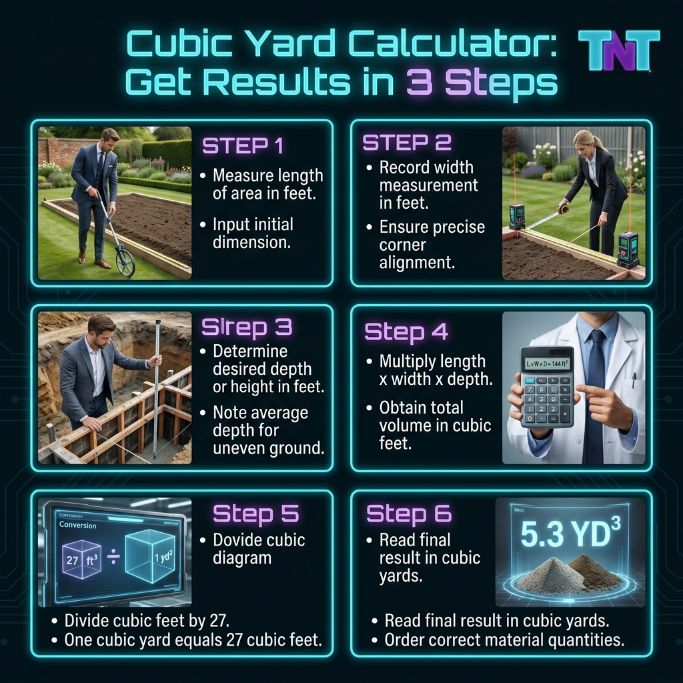
Enter positive measurements. The calculator converts every dimension to feet, calculates cubic feet, divides by 27, adds waste, and rounds the order quantity to your chosen increment.
🧠 How This Cubic Yards Calculator Works
The tool follows the same dependable volume method used for rectangular project areas, then adds practical ordering controls.
Each measurement is converted to feet, so you can mix feet, inches, yards, meters, or centimeters without doing manual conversions.
Length × width × depth gives cubic feet. The cubic yard calculator then divides that value by 27.
The selected waste percentage is added, and the final amount is rounded upward to a practical purchasing increment.
🔄 Cubic Yard Calculation Example
Here is a clear example for a 12-foot by 10-foot gravel area with a 4-inch depth and an 8% allowance.
🧩 Before: Raw Measurements
Length: 12 feet
Width: 10 feet
Depth: 4 inches
Waste allowance: 8%
✨ After: Purchase-Ready Result
Raw volume: 40 ÷ 27 = 1.48 cubic yards.
1.48 × 1.08 = 1.60 cubic yardsRecommended order: 1.75 cubic yards when rounding upward to the nearest 0.25 cubic yard.
📚 What Is a Cubic Yard Calculator?
A cubic yard calculator is a volume-planning tool for landscaping, construction, gardening, excavation, and material delivery. It answers a practical question: how many cubic yards of material are needed to fill a three-dimensional space? Instead of guessing from square footage alone, the calculator combines length, width, and depth.
One cubic yard contains 27 cubic feet. That relationship matters because many project measurements are taken in feet and inches, while bulk mulch, gravel, topsoil, sand, and concrete are commonly discussed in cubic yards. The calculator handles the conversion and presents both the raw mathematical volume and a more practical recommended order.
This cubic yards calculator is especially useful when depth is entered in inches. A small depth error can noticeably change a large-area estimate. Measuring several locations and using an average depth can improve the result on sloped or uneven ground.
For an authoritative unit reference, the National Institute of Standards and Technology lists one cubic yard as exactly 27 cubic feet in its measurement tables. Review the 📖 NIST unit conversion reference for additional volume relationships.
📊 Cubic Yard Conversion and Project Table
Use this table for fast checks, then use the calculator above for project-specific measurements.
| Reference | Equivalent | Practical Use | Planning Note |
|---|---|---|---|
| 1 cubic yard | 27 cubic feet | Bulk material conversion | Exact relationship. |
| 1 cubic yard | 0.764554857984 cubic meters | Metric conversion | Useful for international specifications. |
| 100 ft² at 1 inch | About 0.31 yd³ | Thin topdressing | Add waste only when appropriate. |
| 100 ft² at 3 inches | About 0.93 yd³ | Mulch or shallow gravel | Depth consistency matters. |
| 100 ft² at 6 inches | About 1.85 yd³ | Deep base or soil layer | Compaction can affect ordering. |
| 2 ft³ bag | 13.5 bags per yd³ | Comparing bulk and bagged material | Round bag counts upward. |
✅ Cubic Yard Project Readiness Checklist
Check each item before ordering. Your progress is saved in this browser.
🖼️ Cubic Yard Calculator Infographic
Open the full-size visual guide for a quick, shareable explanation of the measurement and conversion process.
🎮 Cubic Yard Mastery Quiz
Test your planning knowledge. Score three out of three to unlock the “Volume Pro” message.
🎯 How to Improve Cubic Yard Accuracy
📐 Measure the real shape
Break irregular areas into rectangles, calculate each section separately, and add the results. For circular areas, use an appropriate circle-volume formula rather than treating the project as a rectangle.
- Measure in several locations.
- Keep units attached to every measurement.
- Use average depth on uneven ground.
- Round only after the full calculation.
🚚 Plan for real-world ordering
A mathematical result and a supplier order are not always identical. Bulk density, moisture, compaction, delivery limits, and minimum-order rules can affect the quantity you purchase.
- Ask whether the material is sold by volume or weight.
- Confirm truck capacity and access.
- Check whether the quoted price includes delivery.
- Discuss critical concrete quantities with a professional.
🔗 Continue Planning with Tests and Tools
Use these related calculators to move from volume planning to a more complete project estimate.
Explore practical online tools, calculators, and guides.
🧮 All CalculatorsBrowse the full calculator library.
🏗️ Construction CalculatorsFind project-focused measurement and estimating tools.
📏 Linear Feet CalculatorEstimate total linear footage for edges, boards, and runs.
🏖️ Sand CalculatorEstimate sand volume for bases, fills, and landscaping.
🪨 Gravel CalculatorPlan gravel quantities for driveways, paths, and drainage.
❓ Cubic Yard Calculator FAQ
Open any question to see a concise answer.