
🔍 Master the Art of Cryptography with Our Ultimate Cipher Decoder Guide
Welcome to Tests and Tools, your premier hub for digital puzzle solving and linguistic analysis. In an age dominated by information, understanding how to reveal hidden messages is both a vital skill and a thrilling challenge. Our robust cipher decoder is engineered to translate encrypted text—known as ciphertext—back into its original, readable form. Whether you are a cybersecurity student, a puzzle enthusiast, or just curious about ancient scripts, this tool provides a comprehensive ciphertext decoder solution.
The first step in decryption is identification. A specialized cipher identifier analyzes the patterns within the scrambled text to suggest the most likely encryption method used. If your text appears to have shifted letters while keeping the original alphabet structure, it’s likely a substitution cipher. Our shift cipher decoder instantly handles classic examples like ROT13, while our specific caesar cipher translator mathematically reverses the letter shifts. Conversely, if your message consists of numeric strings, our advanced number decoder can identify and crack various types of number cipher systems. In every case, this tool serves as your dependable, all-in-one text decoder for uncovering secrets rapidly and accurately.
Before proceeding with complex decryption, ensure your source text is clean and correctly formatted; otherwise, the logic might fail. We highly recommend running your data through our Text Cleaner to remove strange characters or artifacts. If you are preparing a puzzle for others, you can create stylized clues using our Cursive Text Generator. Additionally, for statistical analysis of ciphertext, our Duplicate Word Finder can help identify recurring patterns crucial for frequency analysis. Mastering these fundamental Textual Tools will significantly elevate your decoding proficiency.
🎨 The Logic of Decryption: Visualized
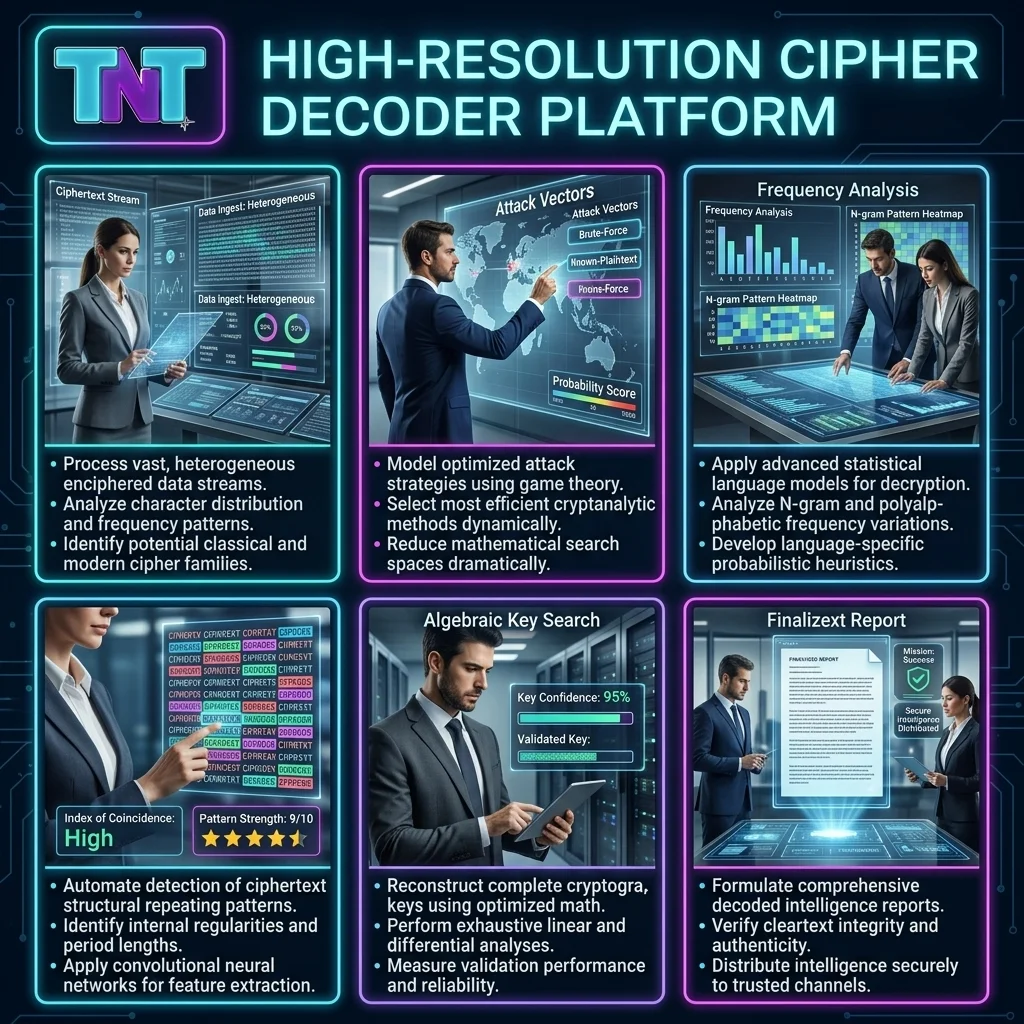
Visual learner? We have prepared a stunning, high-resolution infographic that breaks down the logical flow of our cipher decoder. This guide visually explains how substitution algorithms operate and provides a step-by-step mental model for approaching any new cryptic puzzle.
 ⬇️ Download Full-Size Infographic
📊 Essential Cipher Decoder Reference Table
This table acts as your quick cipher identifier cheat sheet. Understanding the typical characteristics of common encryptions is crucial for selecting the right decoding strategy.
| Cipher Family | Typical Characteristics | Decoding Strategy | Complexity |
|---|---|---|---|
| Caesar Shift | Letters shifted by a fixed value (e.g., A=D, B=E). Word length remains the same. | Use a caesar cipher translator. Test all 25 possible shift values. | Low |
| Substitution (General) | Letters replaced randomly. Frequency of letters matches the original language pattern. | Use frequency analysis (A, E, T are common in English). Requires a robust shift cipher decoder. | Medium |
| A1Z26 Number Cipher | A string of numbers separated by spaces or dashes (e.g., 8-5-12-12-15). | Convert numbers back to letters (1=A, 2=B). Requires a specific number decoder. | Low |
| Polyalphabetic (Vigenère) | Multiple shifts based on a keyword. Standard frequency analysis fails. | Find keyword length first, then solve as multiple Caesar shifts. Standard text decoder needs keyword. | High |
🎮 The Cryptic Challenge
Are you ready to test your skills? We’ve prepared a classic number cipher puzzle. Use your analytical skills or a specialized number decoder logic to find the hidden phrase below!
🗝️ Understanding the Logic of Decryption
Decryption is not magic; it’s mathematical pattern recognition. To successfully crack any message, you must understand the underlying algorithm. A general ciphertext decoder first analyzes letter frequency. In the English language, certain letters like E, T, A, and O appear more frequently than others. If your scrambled text shows 'X' as the most common character, it is a strong cipher identifier indicating that 'X' likely represents 'E'.
Our caesar cipher translator automates this logic by simultaneously trying all 25 possible backward shifts, presenting you with the most likely readable output. However, cryptography extends beyond letters. A number decoder applies logical rules to convert specific numeric strings—like those found in a basic A1Z26 number cipher—back into the alphabet. By combining pattern recognition with specialized logic gates, our text decoder ensures you can unravel layers of obfuscation with surgical precision.
For more extensive study on foundational cryptography concepts, we recommend exploring the excellent interactive course on ciphers at Khan Academy's Cryptography Course. This page offers valuable, rich educational content that pairs perfectly with the practical experience our tool provides.
✅ Decryption Proficiency Checklist
Before finalizing your decoded analysis, guarantee accuracy by following this systematic cryptography workflow:
💡 Frequently Asked Questions
Use our built-in cipher identifier logic. Analyze the characters: if the text is entirely numbers separated by dashes or spaces, it’s a number cipher. If the text looks like jumbled letters but retains normal word length, it is likely a standard substitution or ROT-based cipher.
Yes, because Caesar encoding and decoding use the same algebraic logic. To use our caesar cipher translator for encoding, simply type your plain text and select a shift. For decoding, type the scrambled ciphertext and try different shifts until the output becomes readable.
A general text decoder designed for letter substitutions will fail on numeric data. A specialized number decoder applies logical rules (like mapping 1 to A, 2 to B, etc.) to translate cryptic number sequences back into the English alphabet with 100% precision.