
🛣️ Asphalt Calculator: Estimate Tonnage in 3 Steps
Plan your driveway, parking lot, path, or repair area with an intuitive asphalt calculator. Enter the dimensions, choose a compacted depth and material density, then receive an instant estimate for area, volume, asphalt tonnage, waste allowance, and truckloads.
🚧 What You Will Get
One calculation produces a complete material-planning snapshot:
Enter length and width.
Select depth and density.
Review tons and truckloads.
🧮 Asphalt Tonnage Calculator
⚡ Live Results📏 Step 1: Enter Your Paving Dimensions
🧱 Step 2: Configure the Asphalt Layer
🔄 Before and After: From Measurements to a Purchase Estimate
📝 Before: Raw Project Notes
Driveway: 40 ft × 20 ft
Compacted depth: 3 in
Mix density: 145 lb/ft³
Allowance: 8%
The project has dimensions, but no dependable order quantity yet.
✅ After: Actionable Material Plan
Area: 800 ft²
Compacted volume: 7.41 yd³
Base material: 14.50 US short tons
Recommended order: 15.66 US short tons
The result is ready to discuss with a supplier or paving contractor.
⚙️ How This Asphalt Calculator Works
1️⃣ Calculate Surface Area
Length is multiplied by width and then multiplied by the number of identical areas.
2️⃣ Convert Depth into Volume
The compacted depth is converted to feet or meters before it is multiplied by the surface area.
3️⃣ Convert Volume into Weight
The compacted volume is multiplied by the selected density to estimate asphalt weight.
4️⃣ Add a Planning Allowance
The chosen percentage is added to account for practical site and ordering variability.
Area = Length × Width × Quantity
Volume = Area × Compacted Depth
Base Tons = Volume × Density ÷ 2,000
Recommended Tons = Base Tons × (1 + Allowance ÷ 100)
📋 Asphalt Coverage and Tonnage Reference Table
This quick-reference table uses a nominal density of 145 lb/ft³. It is useful when comparing asphalt calculator square feet to tons results at common compacted depths.
| Compacted Depth | Tons per 1,000 ft² | Approx. ft² per Ton | Common Planning Use |
|---|---|---|---|
| 1 in | 6.04 | 165.5 | Thin overlay or surface correction |
| 1.5 in | 9.06 | 110.3 | Residential resurfacing |
| 2 in | 12.08 | 82.8 | Typical asphalt surface course |
| 2.5 in | 15.10 | 66.2 | Heavier residential use |
| 3 in | 18.13 | 55.2 | Driveways and light-duty paving |
| 4 in | 24.17 | 41.4 | Thicker structural section |
🎯 Choose the Right Asphalt Calculator for Your Paving Project
🔥 Hot Mix Asphalt Calculator
Use the hot mix preset for conventional compacted paving. A hot mix asphalt calculator is most useful when the supplier has confirmed the project mix and target density.
♻️ Crushed Asphalt Calculator
Select the reclaimed asphalt preset for planning a compacted RAP surface or base. A crushed asphalt calculator should use the supplier's actual bulk density whenever possible.
🅿️ Parking and Commercial Areas
Break irregular sites into rectangles, calculate each section, and combine the totals. Confirm pavement design and structural thickness with a qualified professional.
🏠 Residential Driveways
Measure the paved footprint, use the final compacted thickness, and include an allowance for edges, transitions, and ordering constraints.
🧩 Mini Game: Can You Pick the Better Estimate?
A 1,000 ft² area will receive 3 inches of compacted asphalt at 145 lb/ft³. Which base estimate is closest?
✅ Online Asphalt Project Checklist
Complete the checklist before requesting a quote or ordering material.
0 of 8 tasks complete.
Your planning checklist is complete. Verify the final quantity with your supplier or paving professional.
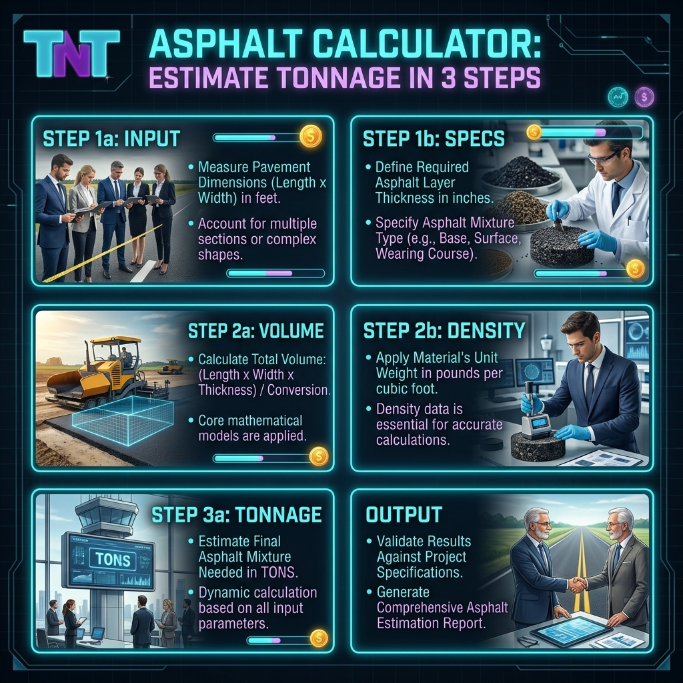
🖼️ Asphalt Calculator Infographic
Save this visual guide for the three-step workflow: measure the site, select compacted depth and density, and convert the resulting volume into a practical tonnage estimate.
📚 Practical Guide to Asphalt Tonnage Estimation
A reliable asphalt calculator turns site dimensions into an estimated material weight. This matters because asphalt is normally ordered by weight, while projects are measured by length, width, and compacted thickness. The conversion becomes straightforward when the area, depth, and density are handled in consistent units.
This resource is intentionally richer than a basic calculator: it combines live tonnage results, truckload planning, an adjustable material allowance, a coverage table, a worked before-and-after example, an online checklist, a learning quiz, an infographic, and practical guidance in one mobile-friendly page.
The most important input is compacted depth. A small thickness change across a large surface can add several tons to the order. Measure the entire paved footprint, account for separate sections, and avoid using loose material depth as though it were the finished compacted depth.
📐 How to Convert Square Feet to Tons
For an imperial project, multiply square feet by depth in feet to obtain cubic feet. Then multiply by density in pounds per cubic foot and divide by 2,000 to obtain US short tons. This is the core asphalt calculator square feet to tons conversion.
⚖️ Why Asphalt Density Matters
Asphalt mixtures are not identical. Aggregate type, gradation, binder content, reclaimed material, and the selected mix design can affect unit weight. The preset values in this tool are useful for early planning, but a supplier-specific density gives a stronger estimate.
🛡️ When to Add a Waste or Ordering Allowance
Real paving sites contain curves, transitions, low areas, variable grades, joints, and practical delivery constraints. A measured allowance can reduce the risk of running short, but an excessive percentage can create unnecessary cost and leftover material. Discuss the final buffer with the contractor.
🏗️ Use Related Construction Calculators
Continue planning with the Cubic Yard Calculator, Sand Calculator, and Gravel Calculator. You can also browse all online calculators or visit the construction calculators hub on Tests and Tools.
🏛️ Authoritative Asphalt Reference
For deeper technical reading on pavement density, construction, and performance, consult the Federal Highway Administration's asphalt density resources . This external reference complements the practical estimating workflow on this page with engineering-focused information from a recognized public authority.
❓ Frequently Asked Questions About the Asphalt Calculator
🧮 How do I calculate how many tons of asphalt I need?
Multiply length by width to find area, convert compacted depth to feet, multiply area by depth to find cubic feet, multiply by asphalt density, and divide by 2,000 for US short tons. Add a practical allowance only after calculating the base tonnage.
📏 How many square feet does one ton of asphalt cover?
Coverage depends on compacted depth and density. At 145 lb/ft³, one ton covers about 165.5 ft² at 1 inch, 82.8 ft² at 2 inches, or 55.2 ft² at 3 inches.
🔥 Can I use this as a hot mix asphalt calculator?
Yes. Select a hot mix preset or enter the density supplied by the asphalt producer. The mix-specific value is preferable when preparing a final order.
♻️ Can this tool estimate crushed or reclaimed asphalt?
Yes. Choose the crushed/reclaimed asphalt preset or enter a custom compacted density. Reclaimed asphalt density varies, so supplier or field information will improve the result.
📦 Should I use loose depth or compacted depth?
Use the final compacted depth for the calculation. Loose-lay thickness can differ because material consolidates during rolling.
🛡️ How much extra asphalt should I order?
The appropriate allowance depends on project geometry, grade variation, supplier minimums, delivery logistics, and contractor practices. The calculator includes an adjustable 0% to 20% planning range.
🚚 How does the truckload estimate work?
The recommended tonnage is divided by the truck capacity you enter, then rounded up to the next whole load for planning purposes.
🎯 Is this asphalt tonnage calculator accurate enough for ordering?
It is designed for useful planning, budgeting, and quote preparation. Verify dimensions, pavement design, mix density, compaction assumptions, and the final order quantity with the supplier or paving contractor.